
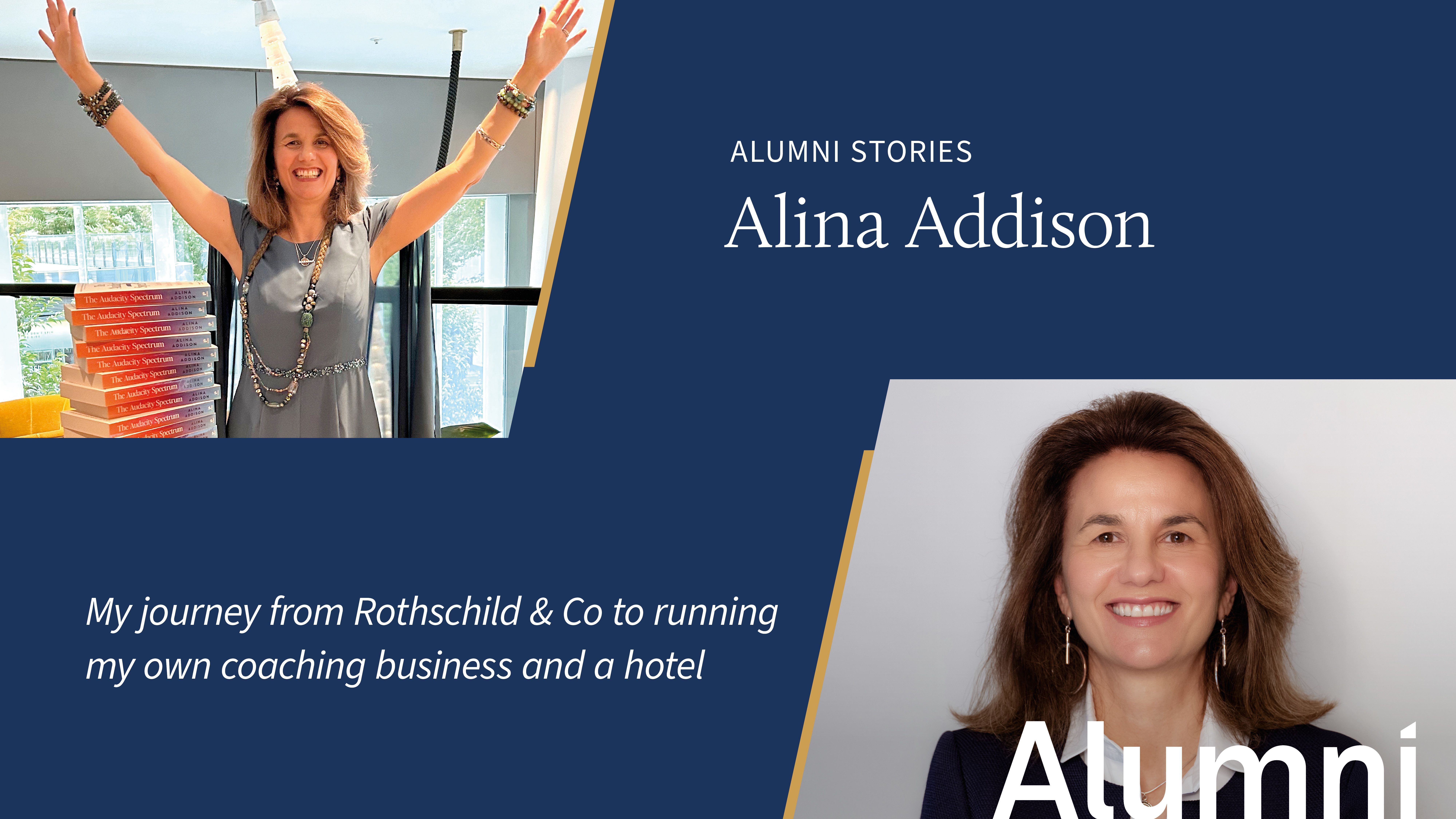
Hi Alina! How did Rothschild & Co help you get where you are today?
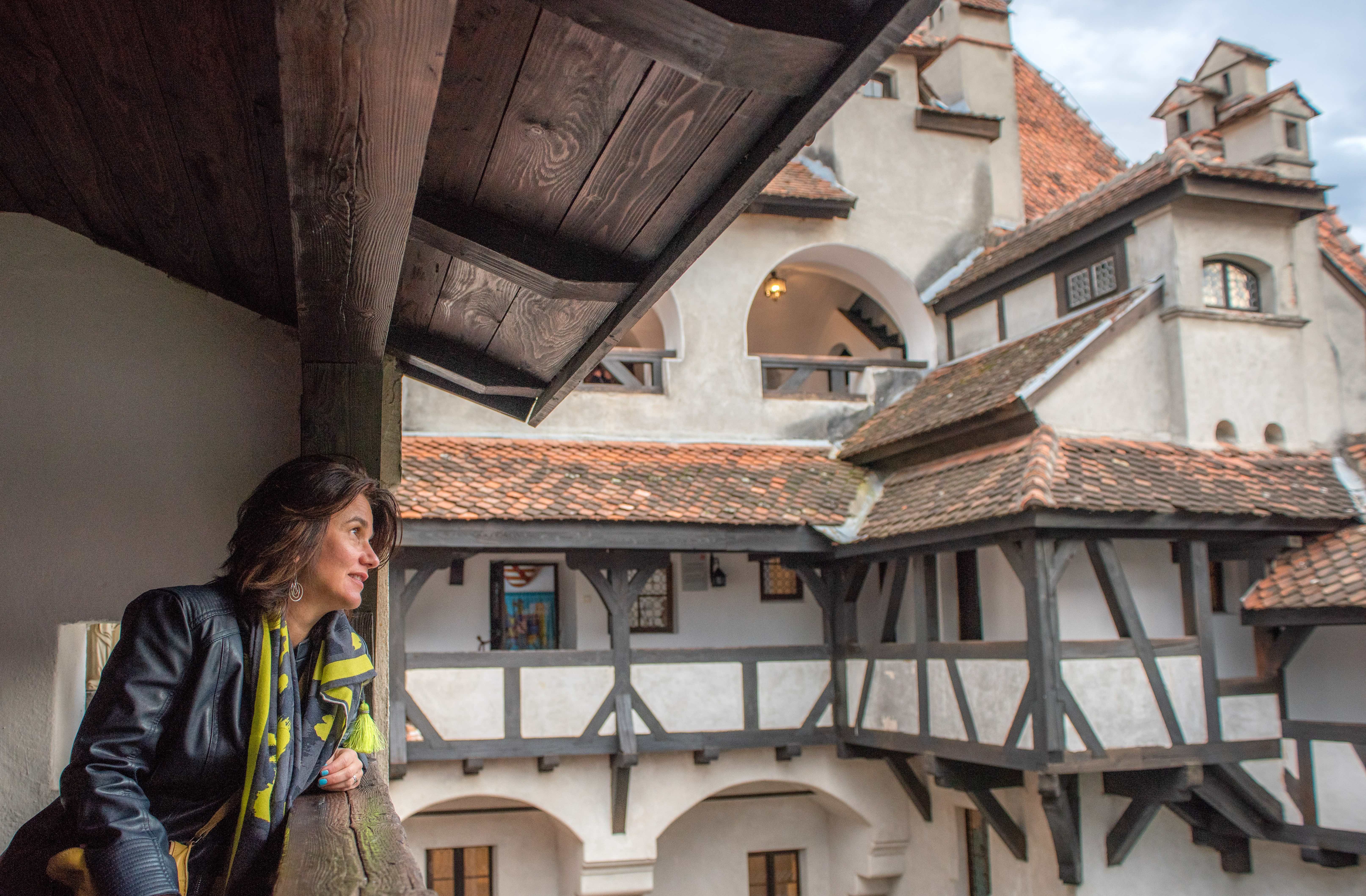
I joined Rothschild & Co in May 2001, and once I had set some money aside from my day job, I had an idea. I grew up in Bucharest, so I mentioned to my dad that I wanted to build a holiday home in Romania. He said: "Are you nuts? Who's going to look after it?" A few glasses of wine later, I suggested: "What about a bed and breakfast?" My dad got excited and asked: "How many rooms?" "Maybe five." Another glass of wine: "Maybe 10." Another glass: "15." We ended up with a 20-room hotel in Transylvania, complete with a conference facility and a beautiful tower that took my dad five years to build. The crowning glory is a spectacular view of Bran Castle, known as Dracula's Castle, the most visited castle in the world.
Has Dracula himself ever booked into your hotel?
Not yet, though we hear about him constantly! Romania had Vlad the Impaler, who inspired Bram Stoker when he wrote Dracula. The story blends history with fantasy in fascinating ways. As part of my work as an executive coach, I now take leaders there for retreats twice a year. Dracula, is the most depicted character in film history and I’m still hoping we meet.
Dracula aside, tell us about your career journey.
I started at Rothschild & Co in London in 2001 and climbed the ladder quickly. I became Head of Trading and Execution for Five Arrows, and was promoted to Managing Director (MD), whilst working four days a week and raising two children. At the time, I was the only person promoted to MD, working part-time, something I'm very proud of. I left Five Arrows in 2016, after my son, Dan, suffered a trauma. When he was nine, he was diagnosed on the autistic spectrum. He's now 21. Everything I do today stems from that moment. Dan was the catalyst for profound change in my life. Dan is high functioning, but with a complex diagnosis. I accepted the diagnosis, but refused to accept the prognosis, which at the time was bleak. I immersed myself in neuroscience and emotional intelligence, essentially becoming an encyclopaedia on the subject.
How did you transition into coaching?
I was introduced to John Smith, an executive coach, through a contact at Rothschild & Co. He had a similar story: he'd worked in financial services when his youngest child was diagnosed with autism. Out of pure kindness, he shared his journey and pointed me toward resources that changed everything. That taught me a lesson I now share with clients: if you don't ask, you don't get. I learned from him, then made the decision to become a coach myself. I went back to school and qualified with the European Mentoring and Coaching Council and the Institute of Leadership and Management in the UK. As I always say, nobody won the Olympics without a coach. What I now do in the corporate world mirrors what sport coaches do. I’m the founder and an Executive Coach at Adaptaa, an Executive Training and Coaching company based in London. I work one-to-one and on a team basis, with managing directors and partners in Private Equity and Asset Management, specialising in Audacious Leadership and Emotional Intelligence. Even incredibly smart people, sometimes need help calming their nervous system and navigating difficult relationships.
What's your approach to dealing with difficult people?
Listen more. Don't go defensive. Be curious.
I typically work with clients over a 6-18 month period. My team and I design programmes, taking highly talented leaders on journeys, which can feel audacious at times. We have just completed a series of leadership programmes for Deutsche Bank, Natixis, GIC and Cinven, teaching participants how to define their personal brand, ask for what they want, navigate the political landscape of the corporate world and remain authentic. I've also written a bestselling book, The Audacity Spectrum. When people ask what I do, I give two answers: first, I give people courage. Second, I help people achieve what they believe is impossible.
Are you part of the Rothschild & Co Alumni Network?
I am. I'd love to read about how other alumni have made an impact in the world.
What do you miss most about Rothschild & Co?
Being surrounded by high-calibre and driven people every day. And visiting Château Lafite, to entertain clients!
Did you get the famous Christmas turkey?
Yes! Those small gestures, as silly as it may sound, made working at Rothschild & Co special. I always chose the medium-sized turkey. Everyone could choose their size, though most people avoided the large one because it wouldn't fit in a normal oven. Maybe the CEO had the biggest oven in town? Rothschild & Co was excellent at corporate responsibility. I served on the charity committee, where colleagues nominated charities and the firm sponsored them. They organised networking events that connected different parts of the business, and there was even a Rothschild & Co Music Society that organised concerts featuring employees and alumni, which is still active today.
Which skills did you learn at Rothschild & Co that you still use today?
So many. I learned to manage up and down, work under pressure, and meet demanding deadlines. I learned that reputation is everything. What you do when no one's watching matters most.
Negotiation was crucial. How do you win when you're competing with others? It's not about winning minds; it's about winning hearts. The best negotiators listen deeply and practice empathy. And whilst I could negotiate with almost anybody, as the Head of Trading, the one person I could not negotiate with, was my own son. He has been my best teacher and my best student.
Perhaps most importantly, I learned about networking, or as I prefer to call it today, "connection." One of my first managers told me: "Alina, networking will be incredibly important for your career. And not just external networking." Internal networking didn't make sense to me at the time, but she was absolutely right. Connection isn’t a science: it’s an art. It's about nurturing, training, managing, and leading people. Former colleagues have brought me into their organisations as a coach, precisely because of those relationships.
How did working at Rothschild & Co help you get where you are today?
Entrepreneurship isn't easy when you come from the corporate world. I gave myself two years to make the transition work. As a trader, I took risks, calculated ones. I still love taking risks, but smart ones. It wasn't easy, and it's never easy, because if it were, everyone would do it. You need courage, faith, and self-belief. And knowing when to pivot if something hasn't worked is an art in itself. My mission with the book is to redefine audacity, not just as boldness, but as three pillars: courage, care, and non-conformity. You can test your own audacity with this QUIZ.
What’s the biggest lesson life has taught you?
If you see something you want, go after it. The worst that can happen is someone says no. Learning to be absolutely okay with rejection is essential. Ironically, my biggest challenge is saying "no" to someone, not receiving one. I don't particularly like saying no, which gets me into trouble. I see everything as an opportunity. The other lesson is reframing into the positive. When I talk about my son, the obstacles are real. I'm not denying reality. Yet, I truly believe everything happens for a reason, that there's a silver lining even in the most difficult moments. I've had plenty of those. As much as my life may look shiny from the outside, what I've learned is that everyone has their crosses to bear. Some are heavier than others, but we all have them.